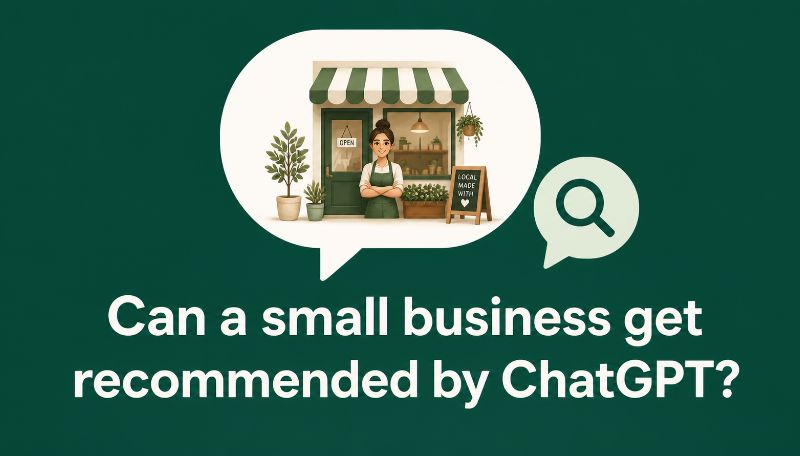
Can a small business really get recommended by ChatGPT?
Short answer: yes! I’ve watched it happen recently with one of my clients, and it’s happened much faster than I thought it would!
When AI search first started getting talked about, I assumed it would be a big brand game. The household names, the huge publishers, the companies with a team of twenty writing content every week. Why would ChatGPT or Google’s AI answers mention a small local business over them?
But it turns out the big players have a weakness… They’re broad. They write for everyone, which often means they write for no one in particular. And that leaves gaps for us smaller guys to fill.
Start with the questions your customers actually ask
This is the bit I now begin every project with. Forget keywords for a minute (although they are still important). What do people say to you before they book, buy or enquire?
Things like “how long does it take?”, “what’s the difference between X and Y?”, “is it worth it for a business my size?”, “what happens if it goes wrong?”
Write those down. Use the real wording, because that’s close to how people type (or speak) into AI tools. If you’re short on ideas, check your emails, your DMs and your reviews. They’re a goldmine.
Look at what the big names are missing
Now search a few of those questions and read what the larger competitors say. Is the answer vague? Is it out of date? Does it skip the awkward bit that you know matters in real life?
That gap is your opening. You don’t need to out-write them – You just need to be more useful on that one question.
Use the stuff only you have
This is where small businesses win. A big brand can’t easily fake these:
- Real customer examples (with permission, of course)
- What you’ve learned from actually doing the work, including the things that didn’t go to plan
- Your own opinion, backed by experience
I think this is why it worked so well for my client. They stopped writing generic explainers and started answering questions the way they’d answer them across the table. Same knowledge they’d always had, just written down properly. This led to a pretty immediate spike in impressions – which in turn led to clicks.
Don’t keep it all on your website
AI tools don’t only read your site. They pick up on what’s said about you in other places too. So it helps to get your expertise in front of people elsewhere: a helpful answer in a local Facebook group, a LinkedIn post, a guest piece for a local organisation, a properly filled-in Google Business Profile, genuine reviews that mention what you actually did for people.
None of this needs to be a big campaign. A little, regularly, adds up.
Track more than AI mentions
It’s tempting to keep typing your business name into ChatGPT to see if you’ve popped up. I get it, I’ve done it too. But the answers change from one day to the next, so it’s a shaky way to measure anything.
I’d look at the bigger picture instead:
- Are enquiries up, or are they better quality?
- Are more people searching for your business name?
- Are new customers telling you they found you through an AI tool or a recommendation?
- Are the right pages getting more visits?
Ask “how did you hear about us?” on every enquiry – It’s free and it tells you loads.
Nobody can promise you a spot in an AI answer
I’d be wary of anyone who does. What you can do is give yourself a much better chance by being the clearest, most helpful, most believable answer to the questions your customers are already asking.
If you’ve got limited time, don’t try to do everything. Pick five questions. Answer them really well. Then see what happens.
And if you’d like a hand working out which five to start with, get in touch. I’d love to help!
FAQs
What is GEO?
GEO stands for generative engine optimisation. It simply means making your content clear and useful enough that AI tools like ChatGPT, Gemini and Google’s AI answers can understand it and are more likely to mention you.
Is GEO different from SEO?
They overlap a lot. Good SEO (helpful content, a tidy site, a strong Google Business Profile) still matters. GEO adds more focus on answering specific questions clearly and on being talked about in places beyond your own website.
Can a small business compete with bigger brands in AI answers?
Yes, in the right areas. Bigger brands often write broad, general content. If you answer specific questions well, using your own experience and real customer examples, you can fill gaps they’ve left.
How do I know what questions to answer?
Start with what customers ask you before they book or buy. Emails, DMs, phone calls and reviews are all good places to look. Use their wording rather than industry terms.
Can you guarantee my business will show up in ChatGPT?
No, and I’d be careful of anyone who says they can. AI answers change and vary from person to person. What you can do is improve your chances by being genuinely helpful and easy to understand.
How long does it take to see results?
It varies, and I’d rather not give you a made-up number. Some businesses notice changes in enquiries or branded searches within a few months, others take longer. Regular, steady work tends to beat a big burst.
How do I measure whether it’s working?
Look at enquiries, branded searches, visits to your key pages, and ask new customers how they found you. Checking AI tools by hand is fine for curiosity, but the answers shift too much to rely on.
Do I need to write a lot of content?
Not at all. Five well-written answers to real customer questions will do more than fifty vague blog posts.